
The Ministry of Spatial Planning, Urbanism, and State Property of Montenegro (Organizer), in collaboration with the Commissioner and Curator of the Montenegrin Pavilion, conducted a Competition for the selection of the conceptual project that will represent Montenegro at the 19th International Architecture Exhibition in Venice – Biennale Architettura 2025.
The Architecture Biennale (Mostra Internazionale di Architettura – Biennale Architettura) is the world’s leading exhibition in the field of architecture, where cross-sectional states are determined, key issues defined, possibilities explored, and future perspectives outlined. This year’s edition of the Biennale is scheduled to take place from May 10 to November 23, 2025, in Venice. Montenegro will mark its participation in this year’s Architecture Biennale by opening its national pavilion in the ArteNova gallery space, located at Campo San Lorenzo in Venice.
The competition was open from January 21 to February 10, 2025. Within the designated timeframe, 11 project proposals were submitted by the following authors:
1. Ivan Šuković, Dejan Todorović, and Emir Šehanović
2. Marko Stjepčević, Nemanja Milićević, Goran Andrejin, and Sonja Dubak
3. KAI Architecture: Danica Pavićević, Emilija Petrinjac, Predrag Krstić, and Lejla Nurković
4. Branislav Redžić, Milica Tasić, and Tamara Radović
5. Aleksandra Mihajlović, Milan Šimšić, Saša Mišković, Luxsika Lunla, Milica Sretenović, Myrsini Alexandridi, Milena Kojić, Maja Budumir, and Rosemary Nasrin
6. Ema Alihodžić, Nora Lefa, and Sara Stojkanović
7. Vasilija Abramović, Oliver Frank Chanarin, and Ruari Glynn
8. APSS INSTITUT: Dijana Vučinić, Vasilije Bušković, Milica Nikolić, Luka Bošković, Anđela Bubanja, Jelena Vućić, and Nikolina Đukanović
9. FEŠTA d.o.o: Veljko Vulanović, Đorđe Šćepanović, Nikola Gogić, Matija Miljanić, and Nikica Lazarević
10. Nikola Joksimović, Itana Ćupić, Relja Ćupić, Stefan Jovičić, Laura Lohmann, and Mili Gazivoda
11. Atelier Marko Brajović: Marko Brajović, Bruno Bezerra, Kelen Tomazelli, Priscila Sati, Luisa Marinho, Teresa Lima, Mana Murphy, and partner Pagu Senna (“Fehra” studio)
Competition Jury:
The jury for selecting the conceptual project to represent Montenegro at this year’s Architecture Biennale consisted of:
• Mirjana Đurišić, Commissioner of Montenegro’s participation at the Architecture Biennale
• Dr. Miljana Zeković, Curator of Montenegro’s participation at the Architecture Biennale
• Dr. Veljko Radulović, Professor at the Faculty of Architecture in Podgorica, University of Montenegro
• Tamara Marović, M.Arch., Member of the creative team for Montenegro’s participation at the Biennale
• Maja Radonjić, M.Arch., Member of the creative team for Montenegro’s participation at the Biennale
The jury unanimously decided that Montenegro will be represented at the 19th Architecture Biennale in Venice by the project authored by Ivan Šuković, Dejan Todorović, and Emir Šehanović.
After final discussions and consultations with each of the shortlisted teams, during the last round of jury deliberation, the jury unanimously selected the project “Terram intelligere: INTERSTITIUM” by Ivan Šuković, Dejan Todorović, and Emir Šehanović as Montenegro’s national representation at the 19th Architecture Biennale in Venice.
Winning Project: “Terram intelligere: INTERSTITIUM”
The project “Terram intelligere: INTERSTITIUM” (“Understanding the Land: Interstitium”) fully met all formal, qualitative, and essential competition requirements. The authors distinguished themselves with their response to the national theme under which Montenegro presents itself at this year’s Biennale—“Understanding the Land”—delivering a fundamental, interdisciplinary project that fosters an understanding and learning across generations and species.
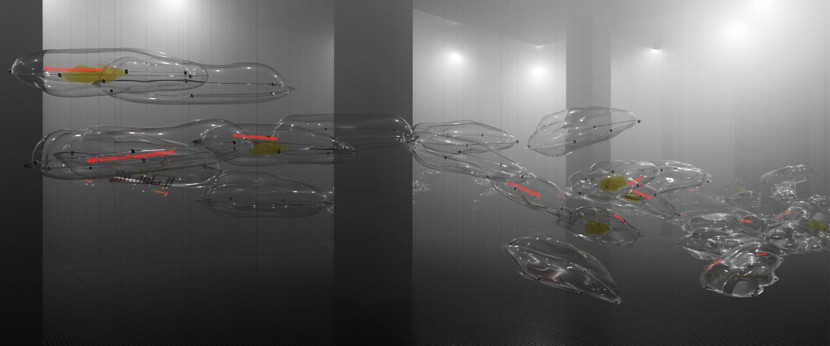
By analyzing the local spatial and cultural phenomenon of “boundaries” (međe)—a defining characteristic of Montenegro—the authors translated this concept into a constellation of inhabited, floating, polycarbonate forms. The resulting spatial structure embodies the dichotomies of past and future, art and science, society and nature, providing a space for encounters and dialogues on sustainable and resilient growth models for natural organisms, human interaction, and future architectural planning.
The architecture of these polycarbonate forms—and their entire constellation—emphasizes the mediatory role of architecture in the future world. It directly responds to Carlo Ratti’s question regarding architecture as an agent and tool for establishing connections between different species and worlds. The installation is conceived as a border space between art and science, bringing forth a micro-world exploration by populating the forms with specific bacterial cultures collected from Montenegrin locations. The project’s scientific basis lies in microbiological research and its potential applications in architecture and construction, making invisible processes accessible and analyzable for visitors.
The “Living Laboratory” established in this way allows for exploration and learning from micro-processes, proposing potential analog applications in future construction practices.
Beyond its exceptional narrative and aesthetic qualities, the project introduces a poetic component, often missing in today’s architectural discourse. By exploring boundaries and their dual nature—both immovable and transient—through different dimensions and scales, the project opens new creative interpretations of the land. As the authors state, it gives “voice to the land—silent, yet deeply present,” shaping a volumetric space for dialogue with and learning from nature.
By integrating all of these components into a single project, the installation offers visitors both scientific insight and emotional resonance, fostering identification with the species that continue to teach us.
In all aspects of qualitative evaluation, the project received exceptionally high ratings, fully justifying its selection for realization.